-
Home
-
China Data
- China Import and Export Data
- China Statistics Import and Export Data(CSD) China Trade Flow Import and Export Data(CTF) China Total Import and Export Data(CTD)
- China Trade Research Monthly Report(CTRMR) China Trade Research Custom-made Report(CTRCR) China Trade Research Yearly Report(CTRYR) China HS Code
-
USA & Canada Data
- USA & Canada Import and Export Data
- US Bills Export Data(USBED) US Statistics Export Data(USSED) US Trade Flow Import and Export Data(USTF) US Total Import and Export Data(USTD) Canada Importers and Exporters(CAIE)
- US Bills Import Data(USBID) US Statistics Import Data(USSID) US Importers and Exporters(USIE) Canada Trade Flow Data (CATF) Canada Total Import and Export Data(CATD)
-
Asia Data
- Asia Import and Export Data
- Indonesia Kazakhstan Sri Lanka Malaysia Philippines Afghanistan
- India South Korea Japan Thailand Jordan Taiwan & Hongkong & Macao
-
Vietnam
Pakistan
Singapore
Turkey
 Uzbekistan
Other Asia Countries
-
Latin America Data
-
Europe & Africa & Oceania Data
- Europe & Africa & Oceania Import and Export Data
- Russia UK Georgia Norway Egypt Australia Samoa
- EU 28 Countries Moldova Azerbaijan Switzerland Botswana New zealand French Polynesia
- Ukraine Spain Belarus South Africa Morocco Fiji Other Countries
-
Market Research
-
Products
 China Data
- USA & Canada Data
- Asia Import and Export Data
- Latin America Data
- Europe & Africa & Oceania Data
- Company & Market Research
-
China Statistics Data(CSD)
China Trade Flow (CTF)
China Total Data(CTD)
China Trade Monthly Report
China Trade Yearly Report
China Trade Custom Report
China HS Code
-
US Bills Export Data(USBED)
US Bills Import Data(USBID)
US Statistics Export Data(USSED)
US Statistics Import Data(USSID)
US Trade Flow (USTF)
US Importers and Exporters(USIE)
US Total Data(USTD)
Canada Trade Flow (CATF)
Canada Importers and Exporters
Canada Total Data(CATD)
-
Indonesia
India
Vietnam
Kazakhstan
South Korea
Pakistan
Sri Lanka
Japan
Singapore
Malaysia
Thailand
Turkey
Philippines
Jordan
Uzbekistan
Afghanistan
Taiwan & Hongkong & Macao
Other Asia Countries
-
Mexico
Brazil
Venezuela
Costa Rica
Bolivia
Honduras
Argentina
Chile
Peru
Colombia
Uruguay
Paraguay
Panama
Ecuador
Nicaragua
EL Salvador
Guatemala
Other Latin America Countries
-
Russia
EU 28 Countries
Ukraine
UK
Moldova
Spain
Georgia
Azerbaijan
Belarus
Norway
Switzerland
South Africa
Egypt
Botswana
Morocco
Australia
New zealand
Fiji
Samoa
French Polynesia
Other Countries
-
Trade Tools
-
About US
-
Contact US

News
2025 Auto Part Export Report
05:09 19 / 10 / 2026
lTotal export value: USD 40.24 billion
lFull-year shipments: 15.97 million batches from 2,701 Mexican exporters to 115 countries & regions
The sector features high market concentration dominated by multinational OEMs and Tier 1 auto suppliers, covering a full spectrum of low-cost bulk trim components to high-value powertrain and automotive electronic systems.
Deep integration with the U.S. automotive supply chain creates major policy risks centered on USMCA origin rules and potential U.S. tariff extensions.
Key Market Characteristics
Exporters
lThe top 10 exporters account for 18.5% of total export value (USD 7.44 billion), while the top 50 exporters represent 55.8% of total value.
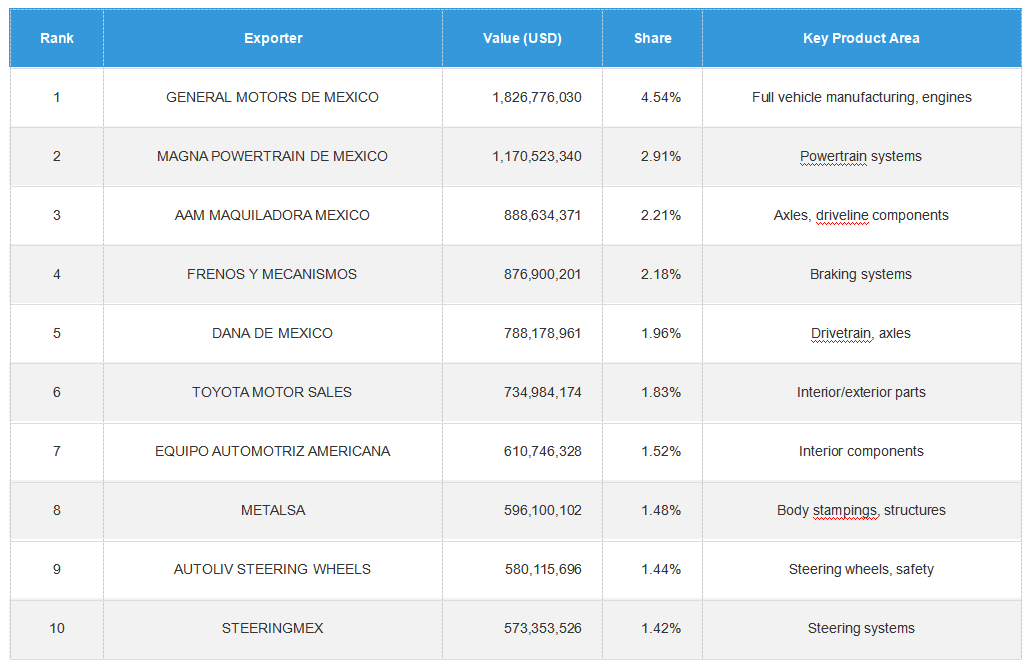
lThe exporter names reveal significant foreign direct investment:
·U.S.-based: GM, Magna, Dana, AAM, Autoliv, TRW, Eaton, BorgWarner, Meritor
·Japanese: Toyota, JATCO, Nissan, Honda, Hitachi Astemo, Denso, Mazda
·German: ZF, Thyssenkrupp, Brose, Schaeffler, Continental, Mahle, Volkswagen
·Korean: Hyundai Mobis, Hyundai Transys, Mando, Hyundai Wia
·French: Faurecia, Valeo
·Chinese: Yanfeng, Tuopu Group, Minth, Xinquan
Importers
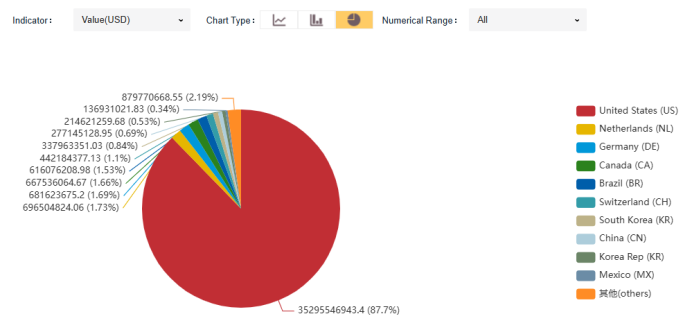
·U.S. Dominance: The U.S. market alone accounts for over 35 billion USD,87.7%
·High-Value Markets: Switzerland and South Korea imports are high-value auto parts
Emerging Markets: Brazil (USD 616M) and China (USD 277M) show growing demand, though volumes remain modest compared to the U.S.
Monthly export Trends
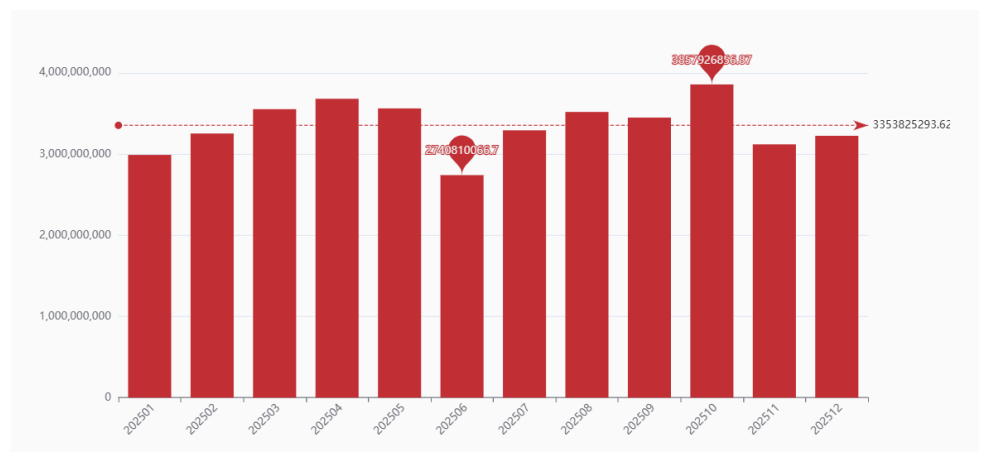
·The export trend shows a clear seasonal pattern with a strong first half, peaking in April ($2.65B) and June ($2.73B). A notable dip occurred in June ($1.97B) compared to the surrounding months, followed by a recovery. The year ended on a relatively lower note in November ($2.22B) and December ($2.38B).
Key Strategic Takeaways
1. Implement Real-Time Supply Chain Monitoring
Track key suppliers’ trade data and set alerts for abnormal supply chain shifts.
2. Conduct Tariff Exposure Analysis
Match suppliers’ goods to tariff codes and evaluate tariffs’ profit impact on high-value exporters.
3. Evaluate Alternative Sourcing Options
Find substitute suppliers and watch non-US markets to offset US tariff risks.
4. Strengthen Compliance & Documentation
Complete standard USMCA certificates and check qualified regional value content ratios.
5. Leverage Trade Intelligence for Negotiation
Use historical trade data to benchmark and bargain favorable terms with suppliers.
6. Scenario Planning
Simulate 10%-25% tariff rates to spot vulnerable auto parts exporters in advance.
Conclusion
The 2025 data clearly shows Mexico's vital role as a manufacturing hub for the North American automotive industry. However, this interdependence is now under threat from aggressive U.S. tariff policies.